

If you’ve ever placed trades that were doing great at first… only to give all that profit back later, then this video is for you.
I’m going to walk you through some key mindset shifts and money management techniques that can help you stop that cycle and make your trading more consistently profitable.
After coaching people for over a decade in options trading, I’ve seen common patterns—why traders lose profits, what mistakes they make, and more importantly, how they can fix it.

Today, we’re going to focus on the money management part of trading.
The 3 Keys to Trading Success
To trade successfully, you need three things:
- A strategy or method (most traders focus only on this).
- Money management – this is what we’re diving into today.
- A strong mindset.
It’s not just about placing trades. It’s about how you manage your money across trades and over time.
The Problem Most Traders Face
Here’s a common issue:
You do one big trade. You win. Great.
Then you do a few more… and suddenly, you give it all back.
The problem? There’s no structure. No system for managing risk or capital.
So today, I want to introduce a concept I call the Trading Bucket Method—a strategy we teach in one of our core classes.
The Trading Bucket Method – Covered Calls Example
Let’s use Disney stock as an example.
Say you buy 100 shares of Disney and start trading covered calls.
Here’s how it works in simple terms:
- Owning the stock is like owning a house.
- Selling covered calls is like renting out that house—you get paid while you wait for the stock to move.
- You make money from the stock appreciation (if the stock goes up) and from the premium (your “rental income”).
The Disney Example – Turning a Loss Around
Now imagine this…
You buy Disney stock and it drops. You’re down $500. Ouch.
But instead of panic-selling, you keep selling covered calls:
- Week 1: +$125
- Week 2: +$95
- Now you’re only down $280
- Week 3: +$110
- Down to $170
- Week 4: +$125
- Week 5: +$90
- Now you’re up $5 overall!
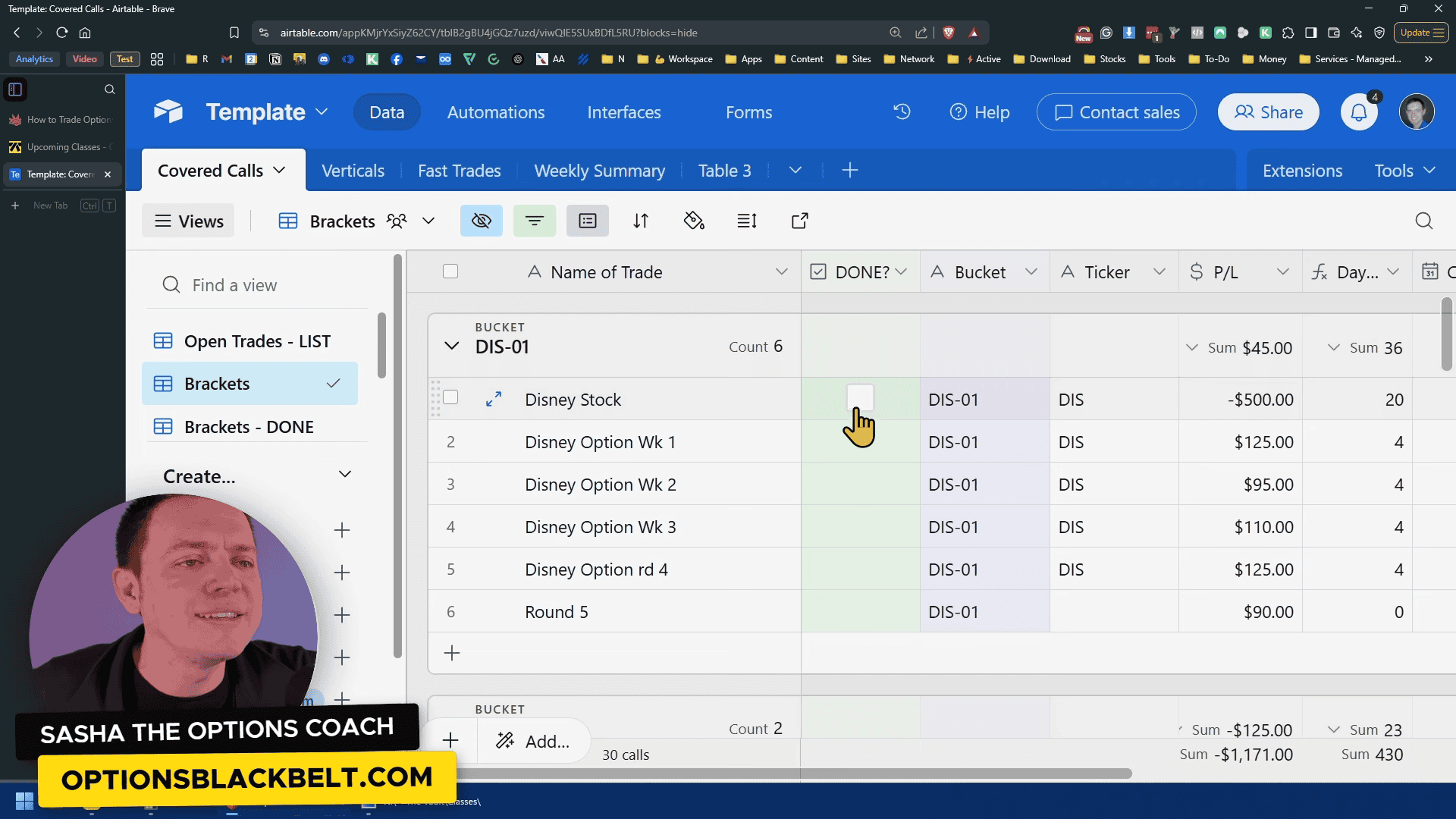
It may not seem like much, but you turned a losing position into a win through smart money management.
Once that group becomes profitable, you can clear the deck—reset and start a new cycle.
Think Like a Business Owner
This is how you should look at your trades:
- Group them into “buckets” or “portfolios”
- Track inputs (capital) and outputs (profits/losses)
- Manage them like business units—each trade is like a rental property or asset
Some trades win fast. Others take a while, and you “chip away” at the loss until it turns into a gain.

You might be running 3-5 of these “property groups” (or buckets) at once. Maybe some in covered calls, others in verticals or iron condors.
The point is to stop thinking in individual trades—and start thinking like a business owner managing a portfolio.
Final Thoughts
Covered calls make this easier to explain, but this applies across the board—iron condors, vertical spreads, butterflies—you name it.
The key is structure.
Think in terms of buckets, manage your trades as income and expenses, and stay consistent.
That’s how you avoid giving back your profits… and start trading like a pro.

